|
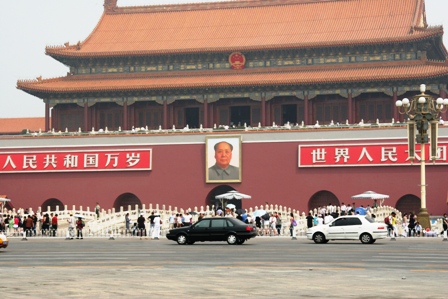 The itinerary for the day was to see the sights of Beijing including
Tiananmen Square, which means ironically "Gate of Heavenly Peace" in
Chinese. Sixteen years before, found this 100-acre plaza jammed
with students and peasants demonstrating for freedom. The dead and
the debris have long since been removed. On this early June day, I
stood in the midst of this colossal expanse measuring nearly one
square mile. The sun shone brightly even through the ubiquitous
Beijing smog.
The itinerary for the day was to see the sights of Beijing including
Tiananmen Square, which means ironically "Gate of Heavenly Peace" in
Chinese. Sixteen years before, found this 100-acre plaza jammed
with students and peasants demonstrating for freedom. The dead and
the debris have long since been removed. On this early June day, I
stood in the midst of this colossal expanse measuring nearly one
square mile. The sun shone brightly even through the ubiquitous
Beijing smog.
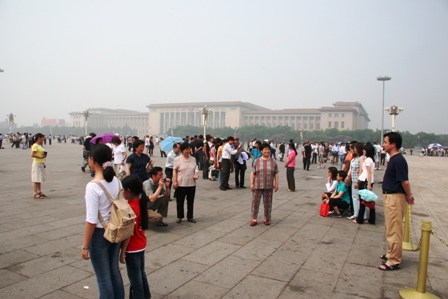 I had taken a group of
university students to China for a class in Chinese history,
religion, and philosophy. The tour guide had dropped off the group
as a soccer mom would hoping for some quiet time. We were free to
wander around Tiananmen for several hours. It is hard visually to
take in this huge this area; it is more difficult to relate to this
sea of concrete. One begins merely to wander aimlessly.
I had taken a group of
university students to China for a class in Chinese history,
religion, and philosophy. The tour guide had dropped off the group
as a soccer mom would hoping for some quiet time. We were free to
wander around Tiananmen for several hours. It is hard visually to
take in this huge this area; it is more difficult to relate to this
sea of concrete. One begins merely to wander aimlessly.
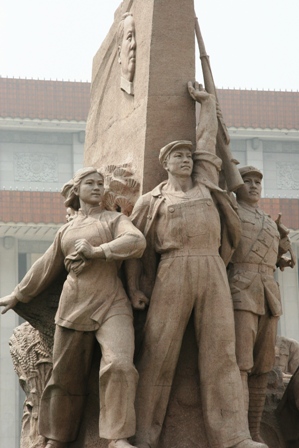 In addition to the enormity of Tiananmen, there isn't much on this
square aside a couple monuments. The size of Tiananmen even dwarfs
the Monument to the People's Heroes located in the center of the
square. There is a very small and slightly elevated stand
containing a couple of modest flagpoles at one end of the square a
couple hundred yards in front in front of the gate into the
Forbidden City with it gateway adorned with a picture of Chairman
Mao.
In addition to the enormity of Tiananmen, there isn't much on this
square aside a couple monuments. The size of Tiananmen even dwarfs
the Monument to the People's Heroes located in the center of the
square. There is a very small and slightly elevated stand
containing a couple of modest flagpoles at one end of the square a
couple hundred yards in front in front of the gate into the
Forbidden City with it gateway adorned with a picture of Chairman
Mao.
The group disembarked from our bus and dispersed like mercury
droplets on a flat surface. We merely wandered around the square
without some equally vast physical object to draw our attention.
All that there was to really see were the people. People were
everywhere. The locals seemed to have acclimated to the size and
were transiting the square pausing only to stop for pictures.
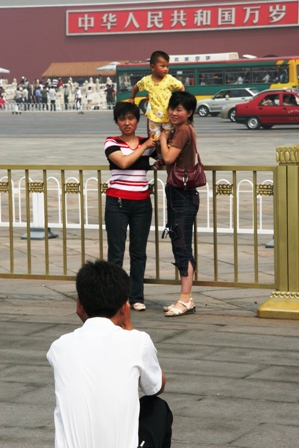
.JPG) It was then that I realized that most of the people were there to
take pictures of each other in this vast void of space. Families,
young lovers, and small groups of adolescent boys or girls were all
there to take snap shots of each other. Some stood so that the
picture of Mao would be their backdrop, but others merely milled
around in the midst of the square and then snapped away. Had I had
the concession of film and memory cards, I could have bought much of
the proverbial tea in China. It wasn't long before I found myself
taking pictures of people taking pictures of each other. There
isn't much else to photograph once I took the gateway to the
Forbidden City and the picture of the Great Helmsmen watching the
tourists.
It was then that I realized that most of the people were there to
take pictures of each other in this vast void of space. Families,
young lovers, and small groups of adolescent boys or girls were all
there to take snap shots of each other. Some stood so that the
picture of Mao would be their backdrop, but others merely milled
around in the midst of the square and then snapped away. Had I had
the concession of film and memory cards, I could have bought much of
the proverbial tea in China. It wasn't long before I found myself
taking pictures of people taking pictures of each other. There
isn't much else to photograph once I took the gateway to the
Forbidden City and the picture of the Great Helmsmen watching the
tourists.
 |
.JPG) |
After an hour in this large
expanse of concrete devoid of almost any physical objects same the
milling thousands who clicked away and then moved away pausing to
pose for another couple of pictures, I was forced to concentrate on
my thoughts within my head. I felt uneasy. What was it that
troubled me? Then came the epiphany; the Chinese people were happy,
laughing, and enjoying this day in June. James Russell Lowell was
thinking of a day like this when he wrote, "And what is so rare as a
day in June?"
How could these Chinese be
enjoying this day in early June there in Tiananmen Square? I had
come to Tiananmen to pay my respects to those killed in a failed
attempt to acquire freedom. However, most of the Chinese were there
to take pictures of each other. That emotional juxtaposition
troubled me for the longest time. I felt like I carried more
reverence for this place than most of the Chinese did. I didn't
think that they should genuflect, but it seemed that taking pictures
of friends and families was a sacrilege. I wouldn't expect tourist
clicking away snapshots of young lovers or families with Golgotha as
a backdrop. I would have thought that they would treat this
hallowed ground with some sort of reverence.
My wife, who had been aware
that I had been lost in my mental meandering for some time, asked,
"What are you thinking? You seem like you are mile away."
I replied that my head was back
at Mt. Lebanon High School, and I was standing in front of Mrs.
Davis, my 12th grade English teacher. Both then and now,
I was desperately trying to remember the words of Carl Sandburg's
poem, Grass:
Pile the bodies high at Austerlitz and Waterloo.
Shovel them under and let me work
I am the grass; I cover all.
And pile them high at Gettysburg
And pile them high Ypres and Verdun.
Shovel them under and let me work.
Two years, ten years, and passengers ask the conductor:
What place is this?
Where are we now?
I am the grass.
Let me work.
|
There on that 100-acre square
which means Gate of Heavenly Peace, the grass has grown high,
thick, and lush. I wondered whether anyone remembered what took
place there exactly sixteen years ago. Apparently, they hadn't. I
had gone to the shrine of Chinese freedom and found grass
flourishing. I left Tiananmen sad. Students and peasants lined
up there and faced tanks and guns demanding freedom. Sixteen year
later, students and peasants lined up to take family photos.
.JPG)
"I am the grass. Let me work."
This article first appeared in the Dixon Telegraph on 9/21/05.
|