






While I Was Looking for My Passport
I’m not the most organized person. Things around the house tend to pile up. However, when something appears on my horizon, I attempt to root through stacks to find something. It is then that I wish I were organized. However, at 83, methinks I won’t have enough years to amend my disorganization.
I went to my bank to get my passport from my safe deposit box. I needed it for a couple of reasons. The first relates to ICE and Border Control wants to acquire a large building complex in Merrillville, IN, which is a couple of minutes from my home. They haven’t been able to find a place large enough for a detention center. Detention centers are similar to 20th-century concentration camps. Talk to people about their experiences when held by ICE. When you were locked up in WWII, it meant that very few would leave alive. In our land, the home of the free, prisoners might live long enough to be flown to another country’s gulag.
The other reason I needed my passport was to fly to Myanmar to see my family and to attend Ti Ti’s graduation from Gusto University. While I am generally disorganized, I can be trusted to protect my passport. I went to my bank and opened my safe deposit box. It wasn’t there. I couldn’t believe it. I couldn’t find it. I returned home and looked all around. Still, I couldn’t find my elusive passport.
I easily found five passports that I have used since my first passport in 1968, nearly six decades ago. I spent a year of post-graduate work at New College of the U. of Edinburgh. During the summer before and after my studies, I traveled all over Europe. That was so long ago, my passport was larger than the rest and was an odd color green.
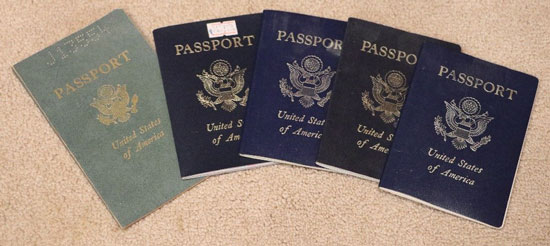
I figured that in my haste at the bank, I missed finding my passport. So, back to the bank. I opened all the folders and envelopes. It wasn’t there. I couldn’t believe it.
However, while reviewing everything in my safe deposit box, I noticed four letters that had been replies to my letters asking them about how to be successful in life. At the time, I wanted to write a book on becoming successful. I had sent out a couple dozen letters. I heard back from four: Leo Buscaglia, Sen. Paul Simon, Rev. Desmond Tutu, and Charles Colson.
I did get another reply. I received it early Saturday morning when my phone rang. I answered the phone to hear John Cleese, one of the Monty Python comedians, ask, “Is this Al Campbell?”
To say that I was shocked and surprised would be a gross understatement. Cleese started the conversation with a comment that he didn’t want to waste the time writing a letter. He preferred chatting. So, for the next hour, Cleese and I chatted about the book that I was writing. It was about what others thought about living a successful life.
Cleese answered my question by asking me what I saw as successful. As I enunciated a litany of what I saw to be successful, he would respond to each of my responses with a desire to know why I felt that way. It was as if I had gone to a Rogerian psychotherapist. It didn’t take me long to realize his technique, and I played along as he helped me understand my life.
This is John Cleese as the owner of Fawlty Towers. Many decades ago, I watched all of the weekly Fawlty Towers more than several times and enjoyed each as if it were the first.
As for the actual replies, this is Dr. Leo Buscaglia's letter.
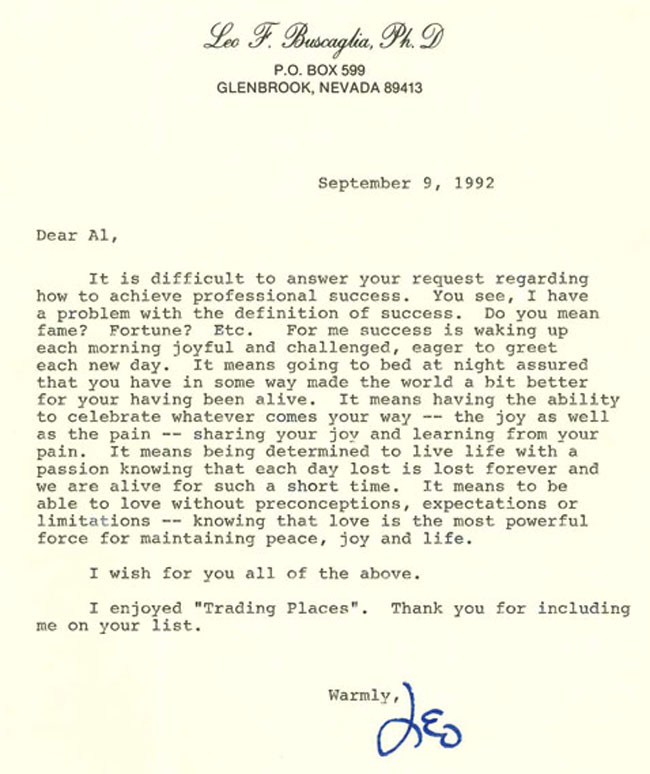
Buscaglia was born in 1924 and named Felice Leonardo Buscaglia. During WWII, he served at a military hospital. He helped reconstruct the wounded faces of soldiers as a result of combat. After the war, Buscaglia went to the University of Southern California for his BA, MA, and PhD. Then he taught at USC.
Buscaglia wrote over two dozen books; five were on The New York Times bestsellers list at the same time. When I read his reply to my letter, I remembered one of his famous quotes: “This might be the only chance I'll ever get to meet you, and I don't want to miss this chance.” I wonder how many letters he wrote to people.
This is one short example of Buscaglia's hundreds of lectures.
This video is about Buscaglia’s lecture about death.
Listen to the last part of Steve Jobs’ commencement address at Stanford. They essentially have similar mindsets.
My second letter is from Sen. Paul Simons.
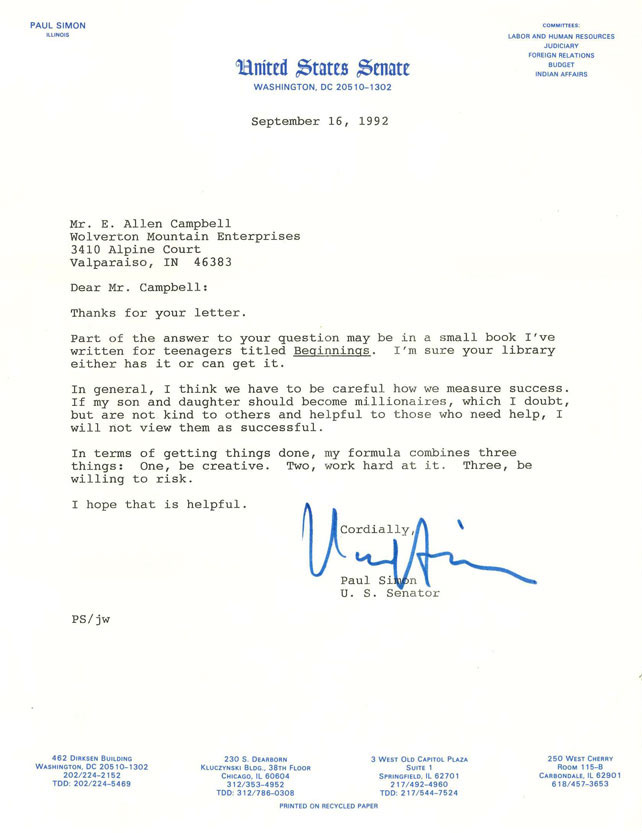
What fascinated me was his three formulas for success. “One, be creative. Two, work hard at it. Three, be willing to risk.”
I am creative, and I work hard. They are a done deal. While risk does work, it scares the hell out of me. I met my family when I was near Inle Lake, Myanmar, a dozen years ago. My family consists of parents and three girls.

Front row: Yamin and Phyo. Back row: Ti Ti, myself, Moh Moh, and Ko Ko
They live in a developing country. During those years, I have wire-transferred money to assist them. Go to GoFundMe.
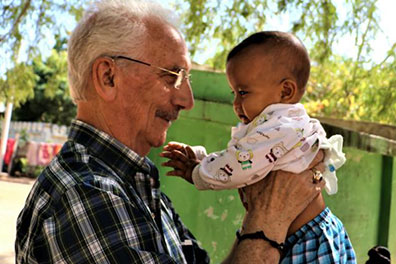
During those years, I discovered my second family. Now, I’m supporting 9 members of my family.

Than, Wattyi, Po, and Khin (From left to right)
I’m 83 and have been assisting my family for years. The annual amount has grown a great deal over the years. It gets scarier as I have refinanced my mortgage, taken out a home equity loan, etc. I don’t enjoy worrying about paying on my home loan.
However, my discomfort regarding my mortgages is real. Nonetheless, I’d much rather deal with the pain of all the mortgages than to know my two families are hurting and in need in Myanmar.
Interestingly, I interviewed Simons several years after exchanging letters. After the interview, he gave me a book he had written on Elijah Lovejoy. Lovejoy was a famous abolitionist, a Presbyterian minister, and newspaper editor in Alton, IL. He was killed by those who wanted to maintain slavery. He had a feeling that he might be killed and wrote: “If the civil authorities refuse to protect me, I must look to God, and if I die, I have determined to make my grave in Alton.”
The third letter that I received was from the Archbishop of Cape Town, South Africa, Desmond Tutu. Tutu had a long life of 90 years, with many years living under apartheid.
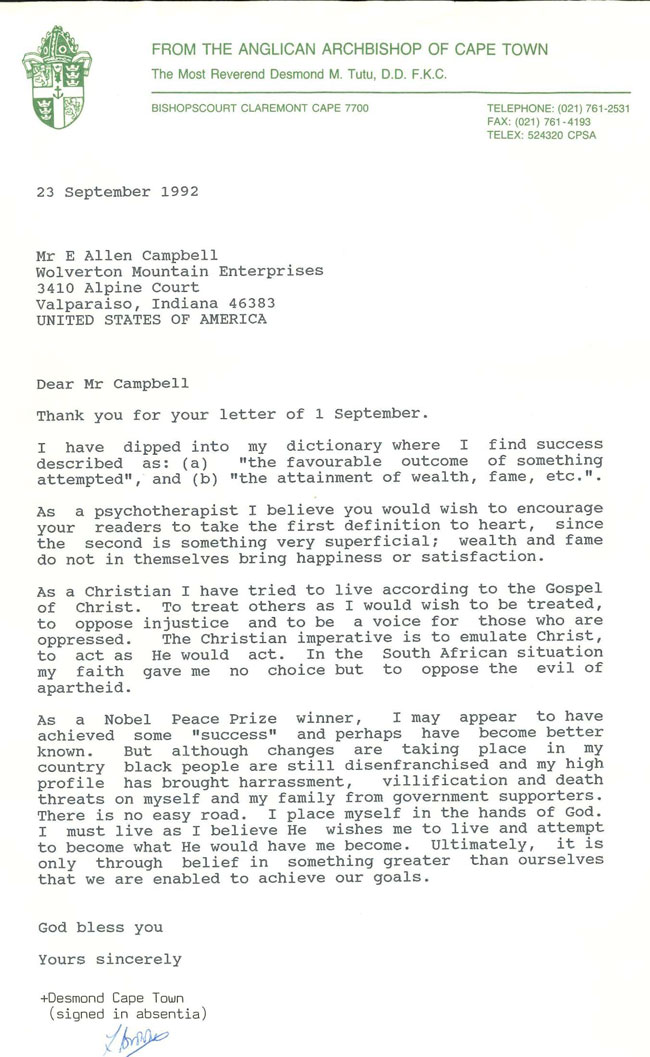
Tutu, like Lovejoy, had concerns over racism. In America, blacks are in the minority, but in South Africa they are in the vast minority. Nevertheless, during the years of apartheid, whites wanted to maintain dominance. He fought for freedom for his people.
When apartheid ended, President Nelson Mandela appointed Tutu to head the Truth and Reconciliation Commission (TRC), which had two major tasks. The first was to investigate past human rights abuses during apartheid. The second was to work for restorative national healing so as to prevent racial abuse in the future.

This is an Al Jazeera presentation dealing with Tutu’s death and his legacy.
The fourth letter was from Charles Colson. Colson was Nixon’s Hatchet Man and Special Counsel to President Richard Nixon.
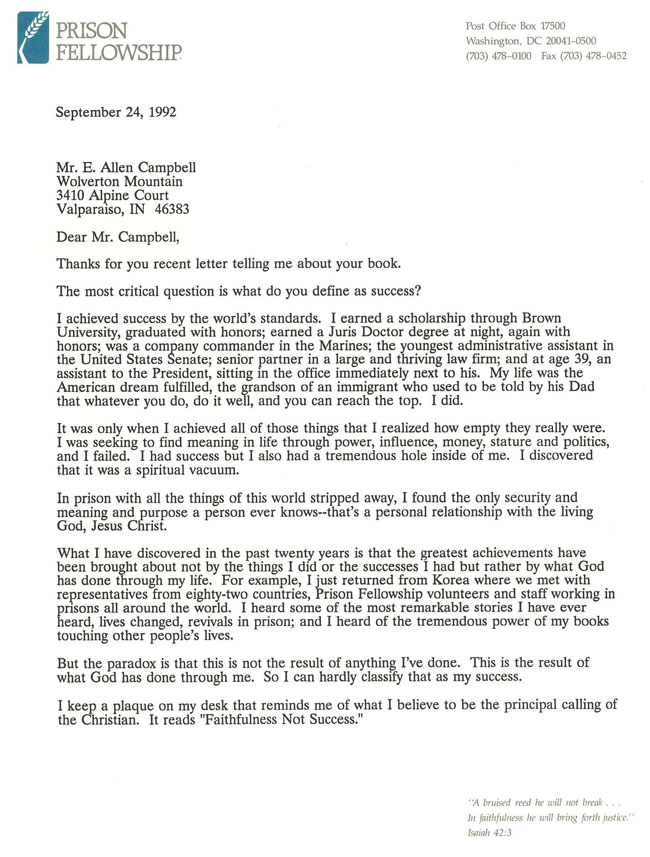
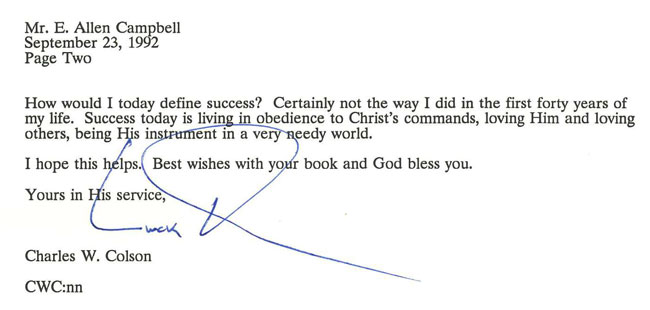
Chuck Colson was one of the most interesting people in American history. I can’t think of a person with a personality that was polar opposite. He was the first of the Nixon administration to go to jail for issues surrounding Watergate. He was one of the Watergate Seven and spent seven months in prison at the Federal Prison Camp, on the grounds of Maxwell Air Force Base in Montgomery, Alabama.
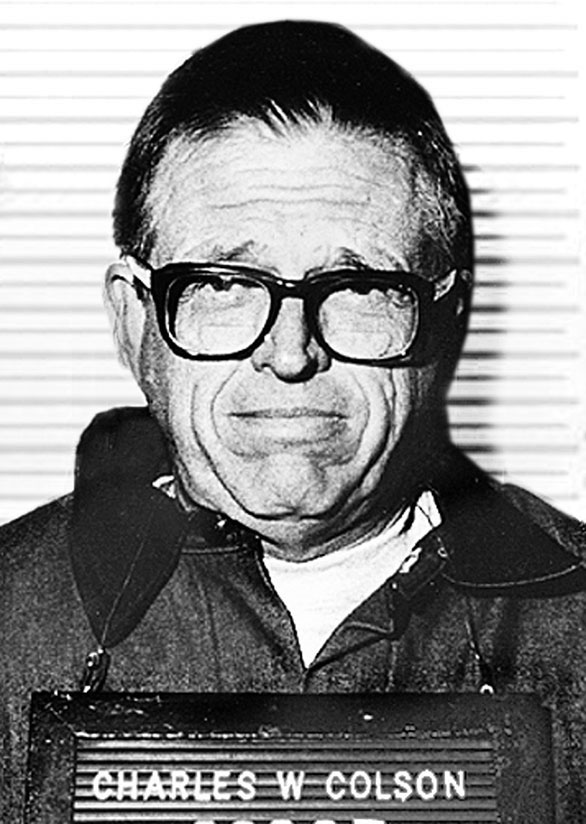
Essentially, Colson went to prison...and saw the light. After doing his time, he was released from prison only to return to prisons throughout America.
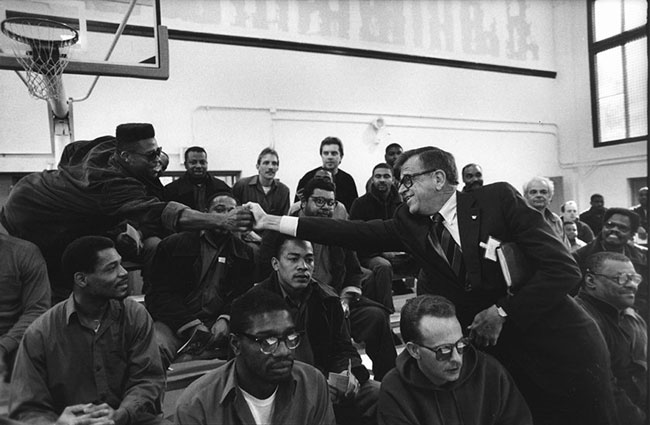
After seeing the light, he spent every Easter visiting a prison. In 2011, Colson returned to Maxwell, where he had been incarcerated years before.
Colson wrote in his letter about a plaque with these three words that was on his desk: Faithfulness Not Success.
I still haven’t found my passport, but I plan to be at Ti Ti’s graduation at Gusto University. Nonetheless, I’m glad that I found these letters.

Visit the On Seeing the Light page to read more about this topic.

Visit the Connecting the Dots page to read more about this topic.

Visit the Ti Ti page to read more about this topic.
Visit the A Ngal Lay page to read more about this topic.

Visit the Living a Life Well Lived page to read more about this topic.
08/28/26