






As Time Goes By
Of all the movies that I have seen, Casablanca is my favorite. A couple of decades ago, while traveling in Morocco, I made it a point to visit Casablanca. If you asked me why I was fascinated by this film noir, there are several reasons. When I was a teaching assistant while at college. The art history class studied Casablanca, which was a precursor of the Italian films a couple of decades later, like La Dolce Vita and La Strada.
The film noir genre of films was based on a cynical and vague moral viewpoint of one or more of he main characters. Another interesting aspect of the storyline of film noir movies was the use of chiaroscuro, Italian for light and shadows.
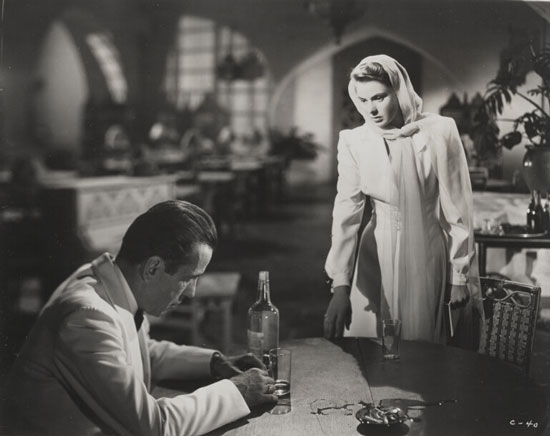
There is hardly a scene in the film that isn’t an example of chiaroscuro.
When I left Casablanca, it was late at night and was just as foggy as in the movie. Ilsa and Laszlo flew off to Lisbon, and I flew off to Chicago.
Casablanca was released selectively in New York City on November 26, 1942. It was released in America on January 23, 1943, just three days after I came into the world.
Humphrey Bogart played Rick Blaine, an expatriate who was born in New York. Rick owned a bar in Casablanca called Rick's Café Américain. Casablanca was controlled by the Vichy French government, which kowtowed to the Nazi’s during WWII.
The storyline of the movie was the on-again, off-again romance between Rick and Ilsa, played by Ingrid Bergman. It started in Paris just prior to the German army's marching into Paris. Their paths went in different directions until Isa winds up in Casablanca at Rick's Café.
This is the scene where Ilsa asks Sam to play As Time Goes By. Sam not only plays it but also sings it until Rick returns to his café.
Years ago, I was aware of Major Strasser, who was in charge of the Nazi presence in Casablanca. The Vichy French Captain Louis Renault was merely a puppet of Strasser.
However, as time goes by in my life, I have learned a great deal more about the movie. This scene at Rick’s, where a group of people sang La Marseillaise as a response to the German officers singing about their country. As it turned out, most of the singers were refugees from France and other places in Europe.
Actually, the international nature of Casablanca goes deeper than those singing La Marseillaise. Except for Rick, Sam, and one of the singers, the rest of the cast weren’t Americans. For example, Conrad Veidt, who played Major Heinrich Strasser, was a German who married a Jewish German, and the two of them fled Germany during the war. Michael Curtiz, who was the director, was a Jewish Hungarian, not an American. He, too, fled his country.
As time goes by in America, it is obvious that America has become the new Casablanca. Our government is deporting refugees, and some are American citizens. Trump said a couple of days ago, “Why can't we have some people from Norway, Sweden, just a few? Let's have a few from Denmark. Do you mind sending us a few people? Send us some nice people. Do you mind? But we always take people from Somalia, places that are a disaster, right? Filthy, dirty, disgusting, ridden with crime.”
Trump asserts, “We will deport all foreigners who are a burden on the public or a security threat and incompatible with Western civilization.” Our orange president uttered that racist nonsense. Maybe being orange makes him better than white nationalists.

Visit the On Seeing the Light page to read more about this topic.

Visit the Connecting the Dots page to read more about this topic.

Visit the Darkest Before Dawn page to read more about this topic.
Visit the Best and Worst of Times page to read more about this topic.

Visit the Living a Life Well Lived page to read more about this topic.

Visit the Gilgamesh page to read more about this topic.
Visit the Man in the Arena page to read more about this topic.

Visit the Donald the Dumb page to read more about this topic.
Visit the Stupid is as Stupid Does page to read more about this topic.
12/12/25