






About Her Canine Patron Saint
This article is a follow-up to the essay regarding addressing history with more clarity and honesty. Before going to bed, Ginger and I chat about various things of interest. On the evening of St. Patrick’s Day, I told her about the patron saint of Irish Setters. She seemed interested in hearing about him.
I began my bedtime story by telling Ginger that St. Patrick wasn’t Irish. He was born in what we call England today. At that time, the Roman Empire ruled all the British Isles, except for Scotland.
Not much is known about St. Patrick’s early life other than he was born in 387 in Kilpatrick, Scotland. However, one thing we do know is that Patrick wasn’t his name. Ginger asked me what his real name was; it was Maewyn Succat. I told her that he was kidnapped by some Irish pirates, who took him to Ireland, where he was essentially a slave who worked as a shepherd in Ireland until his early 20s.
Somehow, St. Patrick was able to escape bondage and fled to Britain. However, he impressed the Catholic hierarchy, and he returned to Ireland as a missionary. He was said to have converted more than 135,000 people and started several hundred churches.
St. Patrick’s birthday and when he died are not known with any certainty. The date that St. Patrick died was, according to legend, March 17, 461. Ginger seemed to grasp that historical data.
Ginger was wide awake and interested, so I continued. I told her the legend that St. Patrick rid Ireland of snakes. It is true that Ireland doesn’t have any snakes. However, as the story goes, he snakes into the sea.
After showing Ginger that video, I explained that it is true that Ireland wasn’t infested with huge python-like snakes, but St. Patrick was the snake exterminator. The Irish climate is too cold for even tiny snakes.
Another fascinating thing that Ginger loved was that in St. Patrick’s time, he wore blue, not green. It wasn’t until the Irish Rebellion in 1793 that green was the color that the insurgents used to differentiate themselves from the English. The color blue was the color of the Irish prior to the time of St. Patrick. Blue was the color of Ireland in its mythology.
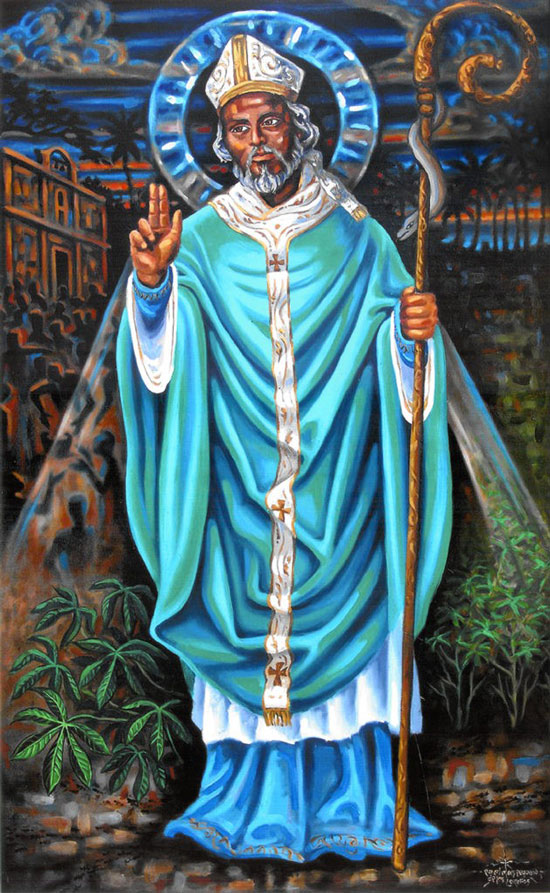
Another interesting thing that was attributed to St. Patrick was the Celtic Cross. As the legend goes, he took the sun-circle and added it to the cross. However, the first Celtic Cross didn’t appear until several centuries after he died.

By now, Ginger was getting tired. So, I told her that there is one more quasi-historical fact before we went to sleep. I asked Ginger who was buried with St. Patrick. That startled her. This item is surely a legend. Supposedly, St. Patrick was buried with St. Brigid of Kildare and St. Columba, who were also saints.
The three saints were buried together outside Down Cathedral in Downpatrick, Northern Ireland.

This is where the three saints are buried. According to legend, St. Patrick, St. Brigid of Kildare, and St. Columba were buried together under a huge granite stone. Knight John de Courey, in 1185, asserts that he discovered the remains of the three saints. Supposedly, they were buried together to avoid the Vikings finding them.

This is another example of writing and rewriting history. Donald wasn’t the first to find it necessary to rewrite history.
Visit the On Seeing the Light page to read more about this topic.

Visit the Connecting the Dots page to read more about this topic.

Visit the Thus Spoke Ginger page to read more about this topic.

Visit the Donald the Dumb page to read more about this topic.

Visit the Stupid is as Stupid Does page to read more about this topic.
03/18/26